Dispersion Compensation Modules (DCMs)

Overview & Market Position

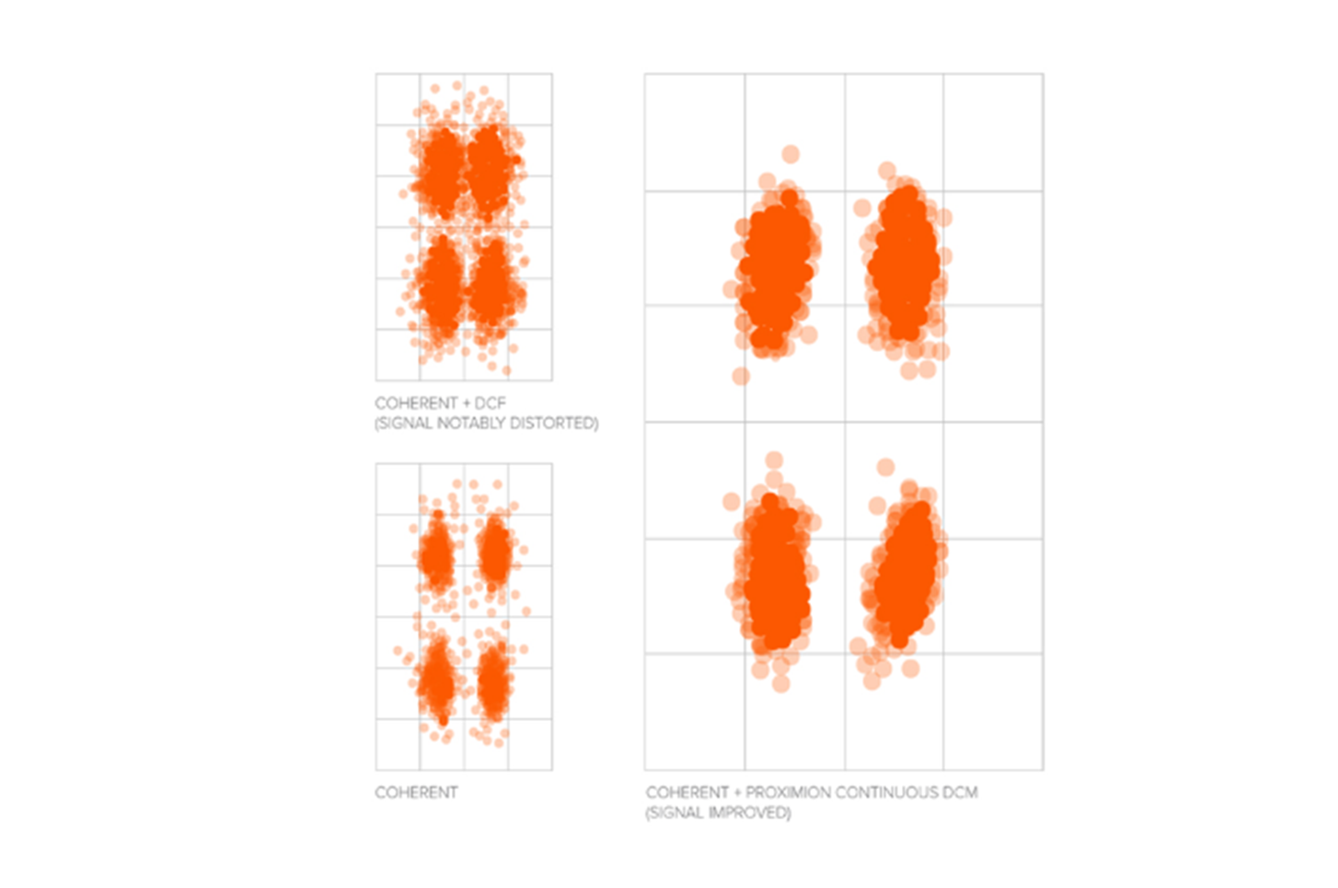
Proximion is unique in offering continuous, chirped‐FBG–based Dispersion Compensation Modules (DCMs) that run across full bands (e.g. C-band / full ITU grid) without segmentation.

Tens of thousands of units have been deployed globally, compensating dispersion over fiber spans that cumulatively exceed more than six laps around the globe. Proximion’s prominence in this space is backed by deep control over FBG fabrication and custom spectral profile design.
TECHNICAL PRINCIPLES

Technical Principles

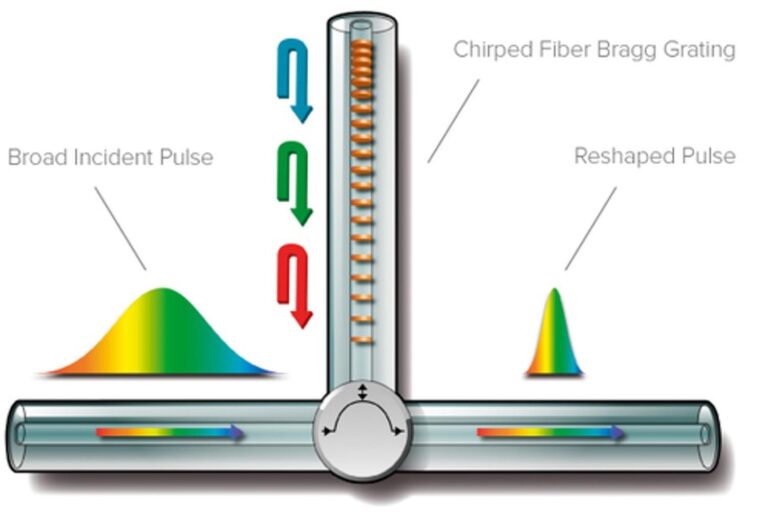
The core mechanism is a chirped Fiber Bragg Grating (FBG) embedded in a circulator loop to introduce wavelength‐dependent delays that counteract dispersion accumulated across fiber links. In effect, faster (shorter wavelength) components are delayed more, aligning them temporally with slower components. Because Proximion’s Dispersion Compensation Modules are continuous (no channel discontinuities), they maintain modulation format and channel plan independence.

Proximion supports customized DCM variants:

  • Continuous full band (e.g. full C-band).
  • Banded / segmented (for systems with limited spectral ranges).
  • Channelized (lower cost, discrete wavelength bands).
  • Continuous slope compensation (for extreme dispersion slope links).

These options allow tailoring to link types (G.652, G.655, custom fiber types) and dispersion slope profiles.

Performance Highlights

From the DCM-HDC datasheet:

  • Cascadable to –150,000ps/nm of chromatic dispersion.
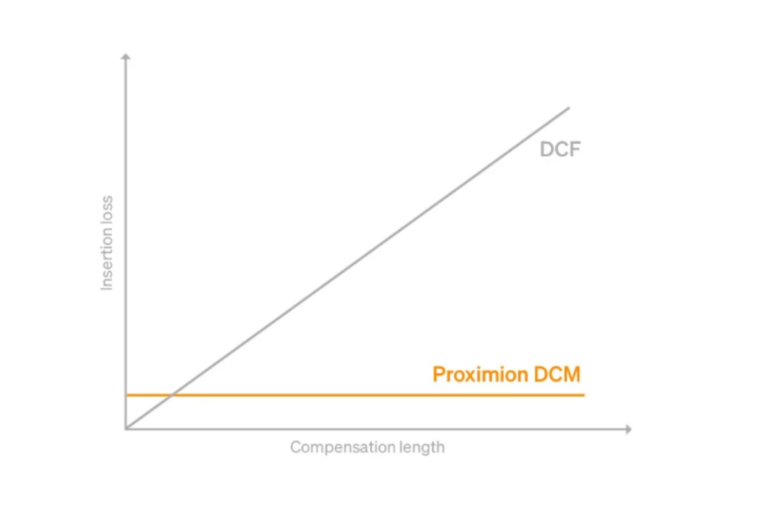
  • Ultra-low insertion loss (a few dB) with negligible added latency (i.e. effective “zero delay”).
  • No nonlinear penalty — the FBG design tolerates high optical power without introducing nonlinear distortion or cross-talk.
  • Continuously operative across the selected spectral band, giving modulation and channel flexibility.
  • Compact form factors: e.g. 198 × 212 × 22.5 mm standard boxes; multi-unit cascades possible.

Because insertion loss is low, system designers have more flexibility in span planning and amplifier placement, potentially reducing amplification cost.

PERFORMANCE HIGHLIGHTS
Dispersion Compensation Modules USE CASES

Use Cases & Applications

  • Ultra-long-haul DWDM networks: To maintain coherent signal fidelity, especially as baud rates increase and dispersion tolerance shrinks.
  • Submarine, festoon, and metro links: In submarine deployments dispersion slope compensation and low nonlinear penalties are critical.
  • Reconfigurable systems: The continuous nature means new channels or re-mapping incur minimal adjustment.
  • C–L band or wideband systems: Because Proximion supports broad bandwidth FBG design, future upgrades can be accommodated.

Competitive Differentiators / Value Proposition

  • Proximion is the only provider of continuous FBG-based DCMs with high production volume.
  • Their in-house ability to customize FBG spectral profiles, from short sensing arrays to long chirped gratings, gives flexibility not commonly matched.
  • Zero or negligible latency makes Dispersion Compensation Modules transparent to time-sensitive systems.
  • No additional nonlinear effects preserve signal integrity, even under high optical power.
  • Tier-1 network vendors frequently deploy Proximion Dispersion Compensation Modules (DCMs), indicating operational reliability and trust.
COMPETITIVE DIFFERENTIATORS
Dispersion Compensation Modules principle

More on Dispersion Compensation

There’s more detailed information on Dispersion Compensation on the following links. Alternatively, you can contact the Proximion team directly, and their experts will be happy to help find the best solution for your needs.

Useful Downloads

Why Choose Proximion

Proven expertise in Fiber Bragg Grating technology and optical dispersion management.
Full in-house design and manufacturing capability ensuring traceability and quality control.
Experience across multiple domains: telecom, energy, defence, aerospace, medical, and research.
Scalable solutions — from prototype development to large-scale production.
Trusted by global industry leaders and research institutions for reliability and precision.