
While DCMs mitigate dispersion in deployed networks, Dispersion Emulation Modules (DEMs) replicate the dispersion characteristics of long fiber spans in a compact, controlled environment. This supports the development, testing, verification, and calibration of new coherent transmission systems before deployment.
Dispersion Emulation Modules (DEMs)
Purpose & Role in R&D / Test Environments
Technical Approach & Capability
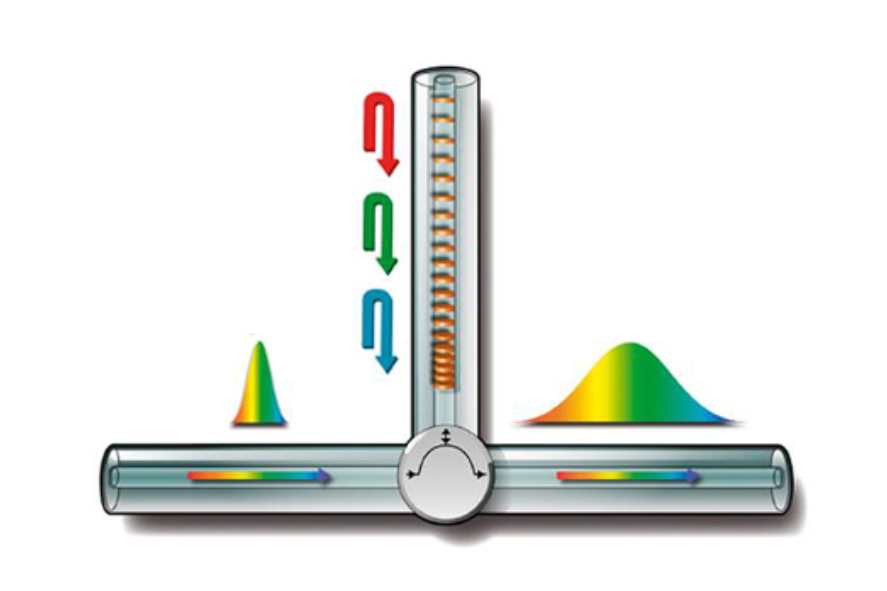
Proximion repurposes its chirped FBG technology to mimic both chromatic dispersion and slope of fiber spans. The same FBG design flexibility means DEMs can match any fiber model (G.652, G.655, custom) with precise slope characteristics. Because these modules use passive FBGs, they avoid nonlinearity — a key advantage over using long DCF spools.
Crucially, Dispersion Emulation Modules support modulation format independence—they do not impose limitations on symbol rates or channel schema.
Key Performance & Differentiator
- Accurate slope matching: DEMs precisely replicate the dispersion slope of real fiber links.
- High optical power tolerance: No nonlinear impairment is introduced even at elevated launch powers.
- Compact footprint: Eliminates the need for kilometres of test fiber, enabling efficient lab setups.
- Repeatable and stable: Environmental stability ensures consistent results across test runs.
Applications
- Verification and qualification of coherent transceivers or DSP modules under controlled dispersion loads.
- Emulating fiber spans in lab environments for link planning, margin testing, or worst-case scenario stress.
- Calibration of network equipment against known impairments.
- Testing new modulation formats or compensation algorithms without requiring physical network setups.
Advantages & Positioning
Proximion’s Dispersion Emulation Modules provide a flexible, precise tool that can replicate any dispersion profile, enabling users to predict performance under real deployment conditions. Because the underlying FBG technology is the same as used in their DCMs, the translation between lab and field is more direct and reliable.