
Improved Signal Reach for QKD (Quantum Key Distribution)

Quantum Constraints & the Role of Dispersion

In QKD (Quantum Key Distribution) systems, signal integrity is paramount: the system typically transmits single photons or extremely weak pulses. Unlike classical systems, standard amplification or regeneration cannot be used since they disrupt the quantum state. Thus, channel impairments—loss, noise, and dispersion—must be managed carefully. Dispersion broadens photon wave packets, lowering temporal correlations and increasing error rates (QBER).

Recent research shows that by compensating dispersion nonlocally (i.e. manipulating only one entangled photon’s path), one can restore timing correlations, thereby boosting secure key rates. In one experiment, a 6.46 km link saw key rate jump from 6.1 bits/s to 228.3 bits/s through nonlocal compensation techniques. arxiv.org

Further, in dispersive-optics QKD (DO-QKD), theoretical work predicts that beyond certain distances, dispersion compensation becomes essential to avoid coincidence peak broadening and degraded secret key rate. In fiber links shorter than ~9 km (in G.652 fiber), the benefit of a DCM may not outweigh its insertion loss, but for longer spans, compensation tends to yield superior net key rates.
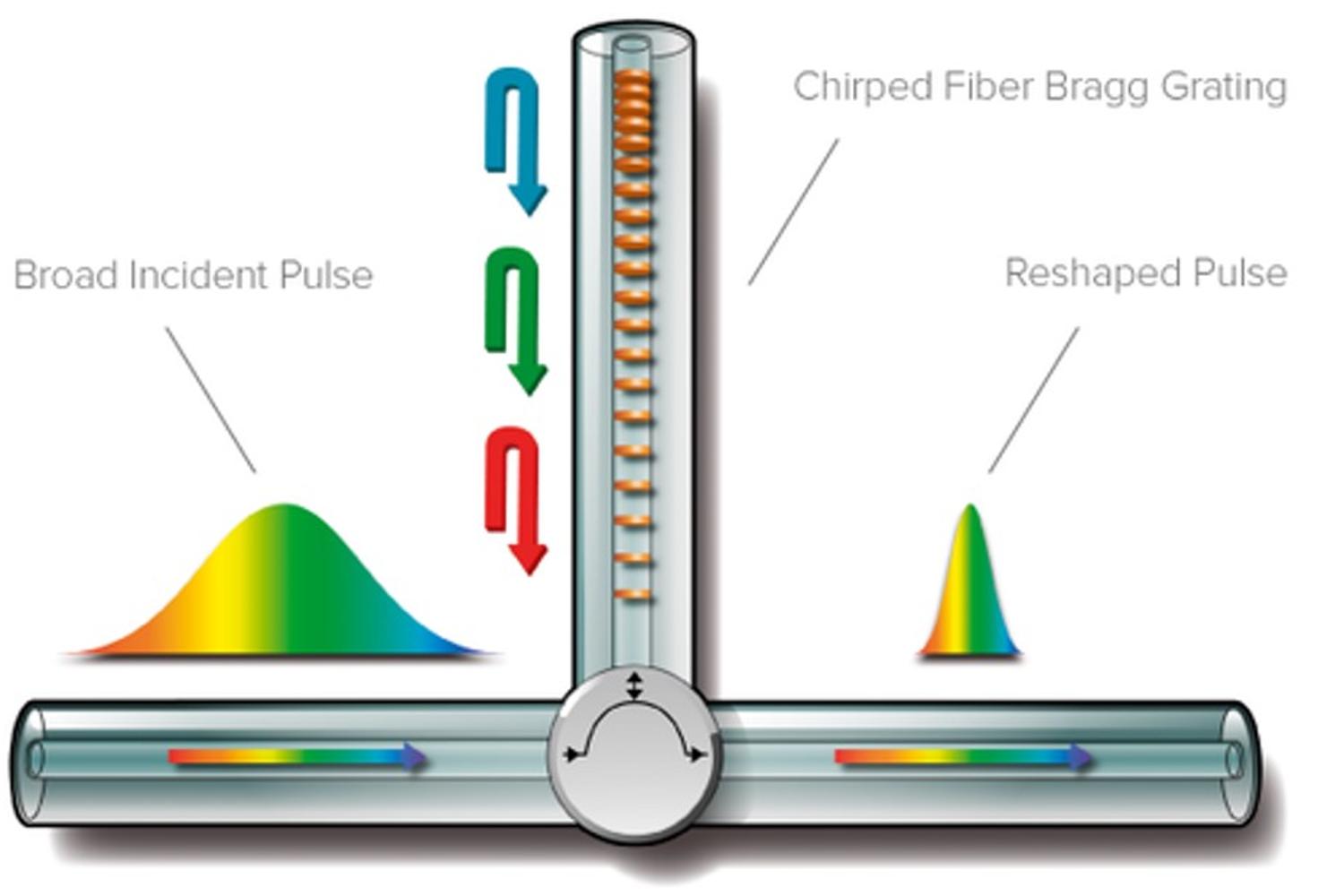

Proximion’s Enabling Approach

Proximion’s ultra-low-loss DCMs and custom dispersion management design can be integrated in QKD links (or trusted-node networks) to preserve photon timing correlations over longer spans. Because their DCMs introduce negligible nonlinearity, they do not degrade quantum states further.

By combining dispersion-optimized FBG design with system-level modelling of photon arrival statistics, Proximion’s solution helps maximize secure key rate and operational distance.

Strategic Benefits & Applications

  • Terrestrial quantum backbone links: Extending QKD spans beyond metro scales without repeaters.
  • Hybrid quantum/telecom overlay: Dispersion modules designed to be compatible with existing fiber infrastructure.
  • Research & prototyping: Enabling new QKD protocol development under realistic link conditions.
  • Satellite-ground QKD links: Compensation for fiber segments in connected networks or hybrid channels (where terrestrial fiber is part of the link).
Strategic benefits and applications
Considerations and trade-offs

Considerations & Trade-offs

  • A balance must be struck between DCM insertion loss and the dispersion compensation gain; in short links, the DCM’s loss may negate benefits.
  • Polarization mode dispersion (PMD) and higher-order dispersion can also degrade entanglement distribution and should be considered in system design.
  • The nonlocal compensation strategy allows using a single DCM for two channels (entangled photons), preserving low-loss performance.

Why Choose Proximion

Proven expertise in Fiber Bragg Grating technology and optical dispersion management.
Full in-house design and manufacturing capability ensuring traceability and quality control.
Experience across multiple domains: telecom, energy, defence, aerospace, medical, and research.
Scalable solutions — from prototype development to large-scale production.
Trusted by global industry leaders and research institutions for reliability and precision.