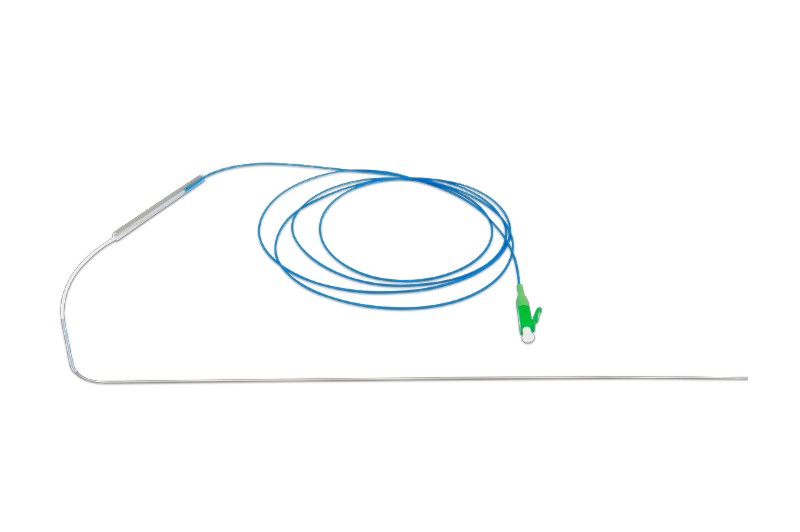
Fiber Bragg Grating (FBG) Optical Sensors

Fiber Optic Sensors

Fiber Bragg Grating (FBG) optical sensors are cutting-edge devices that utilize the principles of light reflection within optical fibers to provide highly accurate and reliable measurements.

They are widely used in industries where precision, durability, and real-time monitoring are critical.
How FBG sensors work

How FBG Sensors Work

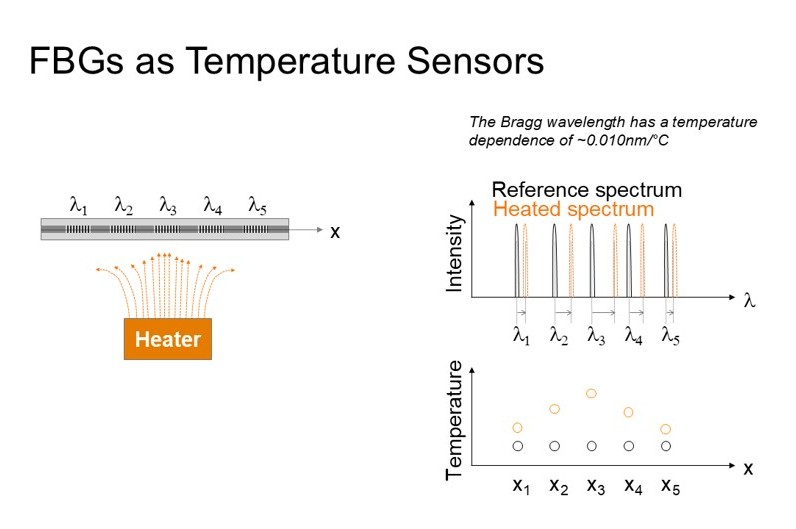
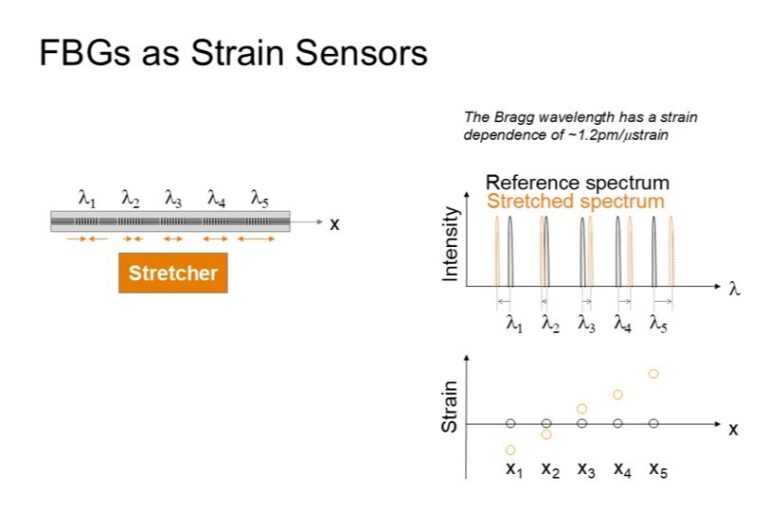
FBG sensors operate by embedding a grating within an optical fiber that reflects specific wavelengths of light. When external conditions such as strain or temperature change, the reflected wavelength shifts.

This shift is measured and converted into precise data, enabling accurate monitoring of various parameters.

Parameters FBG Sensors Can Measure

FBG sensors are versatile and can sense multiple physical parameters, including:

  • Strain – Detects structural deformation or stress.
  • Temperature – Measures thermal variations with high precision.
  • Pressure – Monitors pressure changes in industrial systems.
  • Vibration – Captures dynamic movements and oscillations.
  • Displacement – Tracks positional changes in structures or machinery.
Parameters FBG sensors can measure
Advantages of FBG sensors

Advantages of FBG Sensors

Fiber Bragg Grating or FBG technology offers several benefits over traditional sensing methods:

  • High Accuracy and Sensitivity – Delivers precise measurements even in harsh environments.
  • Electromagnetic Immunity – Unaffected by electromagnetic interference, ensuring stable performance.
  • Multiplexing Capability – Multiple sensors can be installed along a single fiber, reducing complexity and cost.
  • Durability and Longevity – Robust fiber construction with no moving parts makes them ideal for long-term monitoring.
  • Compact and Lightweight – Perfect for applications where space and weight are critical.

Applications of FBG Sensors

Fiber Bragg Grating (FBG) sensors are transforming monitoring and control across various sectors:

  • Aerospace – Monitoring of aircraft structural health and critical systems.
  • Civil Engineering – Bridge, tunnel, and building integrity assessment.
  • Energy – Power grid and pipeline monitoring.
  • Cryogenic – Liquified gas production monitoring and safety surveillance.
  • Healthcare – Medical devices and patient monitoring systems.
  • Industrial Automation – Machinery and process control and optimisation.
Applications of FBG Sensors
Why choose FBG sensors from Proximion

Why Choose FBG Sensors from Proximion?

Proximion has extensive experience in the deployment of FBG optical sensor systems in industrial and critical environments.

Our key competence is to understand the application requirements to design, manufacture and deploy solutions specific to the customer’s need.

Such solutions provide real-time, accurate data for smarter decision-making, improved safety, and optimized performance. Their adaptability and reliability make them the preferred choice for modern sensing solutions for today’s demands to optimise efficiency, enhance sustainability and increase safety.

Useful Downloads

Why Choose Proximion

Proven expertise in Fiber Bragg Grating technology and optical dispersion management.
Full in-house design and manufacturing capability ensuring traceability and quality control.
Experience across multiple domains: telecom, energy, defence, aerospace, medical, and research.
Scalable solutions — from prototype development to large-scale production.
Trusted by global industry leaders and research institutions for reliability and precision.